Every Houston buyer wants a lower rate and a clean closing. In 2026, the difference…
The Ultimate Guide to Bank Statement Loans in Houston, TX
What is a Bank Statement Mortgage and How Does It Work?
For many self-employed professionals and business owners in Houston, proving income through traditional tax returns can be a frustrating hurdle. This is where a bank statement mortgage becomes incredibly valuable. Also known as stated-income loans, these alternative financing options allow borrowers to qualify for a home loan using personal or business bank deposits rather than standard W-2 forms or tax returns.
When you apply for self-employed alternative doc mortgages, lenders typically review either 12-month or 24-month bank statements to calculate your qualifying income. A 12-month review is great for businesses with consistent recent cash flow, while a 24-month review provides a broader picture for businesses with seasonal fluctuations. As experts in the Houston market, Jimmy Rushing and the team at Your TEXAS Home Loan Guy specialize in navigating these non-qualified mortgage (Non-QM) products to find the perfect fit for your unique financial situation.
Exploring Asset-Based and DSCR Loan Options
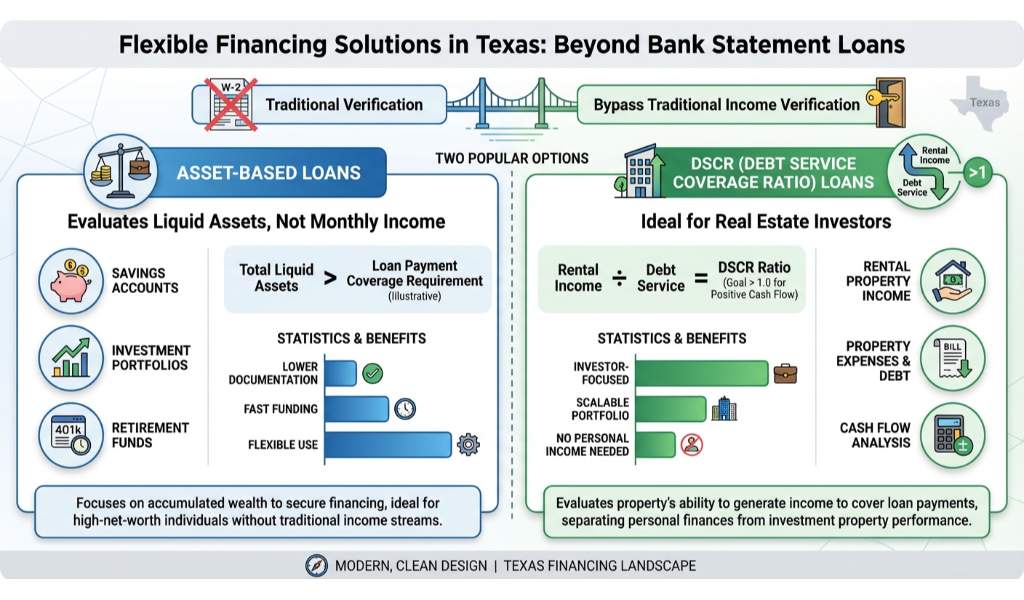
Beyond standard bank statement loans, borrowers in Texas have access to other flexible financing solutions designed to bypass traditional income verification. Two popular options include asset-based loans and DSCR loans.
- Asset-Based Loans: Instead of looking at monthly income, lenders evaluate your liquid assets, such as savings accounts, investment portfolios, and retirement funds, to ensure you can comfortably cover the loan payments.
- DSCR (Debt Service Coverage Ratio) Loans: Ideal for real estate investors, this loan focuses entirely on the cash flow of the investment property itself. If the rental income covers the monthly mortgage payment, you can often qualify without providing personal income documents.
These specialized programs often fall under the umbrella of a portfolio in-house underwritten mortgage, giving lenders the flexibility to make common-sense underwriting decisions. If you have been turned down previously, remember that we are experts at providing second opinions on bank statement loans and alternative financing.
| Loan Type | Best For | Income Verification Method |
|---|---|---|
| 12-Month Bank Statement | Self-employed borrowers with steady recent income | Average of eligible deposits over the last 12 months |
| 24-Month Bank Statement | Business owners with seasonal or fluctuating income | Average of eligible deposits over the last 24 months |
| Asset-Based Loan | High-net-worth individuals and retirees | Depletion or calculation of total liquid assets |
| DSCR Loan | Real estate investors building a property portfolio | Property rental income compared to the mortgage payment |
Why Get a Second Opinion on Your Bank Statement Loan?
Securing a home loan as a self-employed individual does not have to be a stressful experience. However, not all mortgage lenders understand the intricacies of alternative documentation. If you have been quoted a high interest rate, asked for unnecessary paperwork, or flat-out denied, getting a second opinion is crucial.
Jimmy Rushing, your trusted Houston mortgage broker, is an expert at providing second opinions on bank statement loans. We meticulously analyze your 12-month or 24-month bank statements to ensure your income is calculated correctly, maximizing your purchasing power. Whether you are seeking a primary residence or expanding your investment portfolio with a DSCR loan, we have the specialized knowledge to help you succeed.
Q1: What is a bank statement mortgage?
A bank statement mortgage is a type of home loan that allows self-employed borrowers to qualify using their personal or business bank statements to verify income, rather than providing traditional tax returns or W-2 forms.
Q2: Can I use a 12-month bank statement for a home loan in Houston?
Yes, many alternative documentation lenders offer 12-month bank statement programs. They will average your total eligible deposits over the past year to determine your qualifying monthly income.
Q3: How do DSCR loans differ from stated-income loans?
While stated-income or bank statement loans look at the personal or business cash flow of the borrower, a DSCR loan evaluates the rental income potential of an investment property to ensure it covers the mortgage payment, completely ignoring the personal income of the borrower.
Q4: Are bank statement loans considered Non-QM?
Yes, bank statement loans are a type of Non-Qualified Mortgage (Non-QM). This means they do not conform to standard Fannie Mae or Freddie Mac guidelines, allowing for more flexible underwriting criteria.
Q5: Why should I get a second opinion on my bank statement loan?
Not all lenders calculate self-employed income the same way. A second opinion from an expert mortgage broker can often uncover miscalculations, potentially securing you a lower interest rate, better terms, or turning a denial into an approval.
Ready to explore your bank statement loan options?
Contact Jimmy Rushing, Your TEXAS Home Loan Guy, today for a free consultation or an expert second opinion on your loan file.

Related Posts